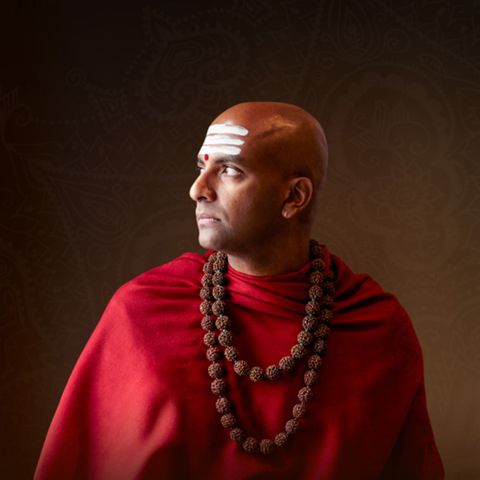
The three lines of ash I wear on my forehead represent three teachings: ego, karma, and delusion. Each one is something to work on every day.
The first line represents ego. In many spiritual circles the instruction is to get rid of the ego. In the philosophy I subscribe to — I belong to the oldest of Hinduism’s four sects — everyone has an ego, and the goal is not to eliminate it but to cultivate a positive one: to become kind, compassionate, empathetic, industrious, charitable.
The second line has to do with karma, the law of cause and effect. Every thought, word, and deed has a repercussion — that is half of karma. The other half is your reactions. If someone insults my shawl, I can choose resentment, or I can decide it is a great opportunity to go shopping. How I respond also determines my outcome.
“By controlling how we act and react, we determine so much of the outcomes in life.”
The third line is delusion — the way we get distracted by things and people unaligned with our priorities. The practice is to keep bringing focus back to who and what matters, understanding that life is finite.
In this conversation I also answer a question I am often asked: does a decade as a cloistered monk make life easy? No. I have the same chaos every entrepreneur has, the same struggles anyone with a family has. The difference is that I was given a set of tools in the monastery and taught how to use them. Every day I have the choice to apply those tools or reap the repercussions of not applying them.
In this teaching
- Why the goal is a positive ego — kind, compassionate, industrious — not no ego.
- How the two halves of karma, your actions and your reactions, put most outcomes in your hands.
- Why tools, not circumstances, determine how well you handle the chaos of life.
Watch the conversation above. Then choose one reaction today and govern it.